The Shapeshifting Face of Diet Culture – and Why Turning Away Is a Radical Act
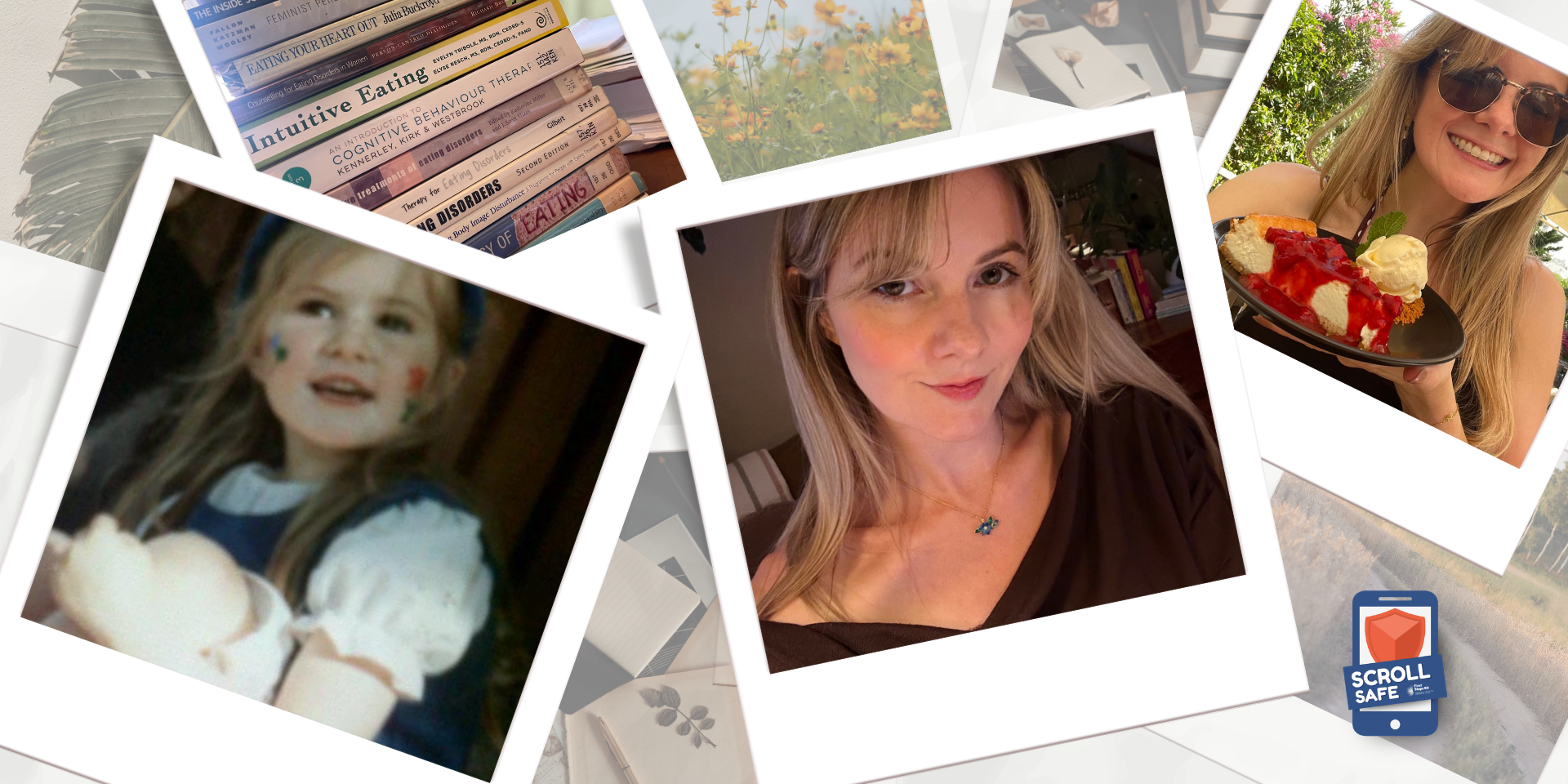
I am a Trainee Psychotherapist with a history of eating disorders. There is a much longer story I could tell about the psychological, genetic and trauma-based factors that contributed to my eating disorders, but that is not today’s story. This blog is about the culture I grew up in, and how navigating diet culture in its ever-changing forms can shape our identity, our recovery and our capacity to remain safely recovered.
I grew up in the 1990s and early 2000s, before TikTok, Instagram or the infinite scroll. I loved Care Bears, Buffy the Vampire Slayer and all things pop and rock music. Sometimes I hear this period spoken about nostalgically, as though growing up before social media meant being protected from the relentless comparison young people experience today. That isn’t how I remember it.
Our version of TikTok and Instagram was television, advertising, music videos and magazines – glossy, heavily edited and deliciously exciting magazines marketed directly to teenage girls, which taught us an enormous amount about which bodies were desirable and which ones apparently needed fixing.
I was obsessed with dance and music. I watched Britney Spears, Christina Aguilera and the girl bands of the era with total awe, absorbing not only their choreography but also the way their bodies were presented and discussed. Female celebrities existed under extraordinary scrutiny: weight loss was news, weight gain was news, visible stomachs were analysed, and bodies were praised, criticised and compared with a casualness that now feels startling.
I remember seeing Jennifer Lopez eating ice cream in the video for I’m Real back in 2001 (side note, an iconic year for music, am I right?). Not long afterwards, I read a magazine interview describing the foods Jenny from the Block supposedly avoided, including carbohydrates, sugar and sweets, because these foods were “the danger”. I was around 13, and the contradiction stayed with me. Food looked joyful, pleasurable and ordinary, but apparently having the “right” body required denying yourself those things while still performing the appearance of effortless enjoyment.
Elsewhere, calorie counting was part of the cultural wallpaper. SlimFast adverts were everywhere, as was the Special K diet. Slim women in red dresses and swimsuits flaunted a lifestyle centred on eating mostly cereal, a concept many dietitians and health professionals would understandably challenge now. At home, I heard family members repeatedly criticise their own bodies, while the media around me seemed to confirm that this anxiety was entirely reasonable, almost essential. The message was remarkably consistent: your body is THE problem to solve, and managing that problem should take up a considerable amount of your time and energy.
What strikes me now is that I wasn’t even living in a larger body then.
As I became more serious about dance as a teenager, mirrors provided another place to monitor myself. Rather than asking what my body could do – how it moved, performed or expressed something – I increasingly learned to observe how it looked. I compared myself with other dancers and noticed how thinness and visible abdominal muscles could attract admiration quite independently of ability. Teachers offered diet tips too, including drinking a glass of water whenever the devil … otherwise known as hunger, kicked in. I was 15.
At the same time, things at home were difficult, and food became a source of comfort and regulation. This isn’t uncommon: research suggests people who identify as emotional eaters are more likely to report difficult childhood family relationships.* My body changed, I visibly gained weight as I moved through my teens, and in a culture where anti-fatness and fatphobia were extraordinarily normalised, that change in my body significant affected how I was treated too.
Looking back, it is not difficult to see how these threads became tangled together. I eventually developed binge eating disorder and bulimia, alongside periods of extreme orthorexia. My eating disorder cannot be reduced to mainstream popular culture; eating disorders are far more complex than that, and plenty of people are exposed to these messages without developing one. But that does not make the messages harmless. They certainly do not cultivate a healthy or sustainable relationship with food and body, even for people without eating disorders.
Ultimately, the culture surrounding me provided fertile ground for my illnesses to flourish. It gave my eating disorder voice a megaphone. I learned restriction before I had the maturity or critical thinking skills to question who benefited from me believing I needed to shrink.
For teenagers growing up today, the delivery system is different, but the messages are depressingly familiar. A young person may no longer wait for the next issue of a magazine to find out how their body supposedly measures up; instead, they can encounter hundreds of bodies and “skinny tips” before breakfast. Algorithms can learn what holds their attention and repeatedly serve variations of it, while content romanticising extreme thinness, calorie restriction or rapid weight loss can sit alongside ostensibly wholesome material about “healthy eating”, morning routines, wellness and self-improvement. “SkinnyTok” is perhaps the most obvious recent example of diet culture getting an algorithmic rebrand. No magazine subscription required – and unlike a magazine, the algorithm learns and adapts.
Meanwhile, we are again seeing very thin bodies increasingly celebrated across fashion, Hollywood and popular culture. Bodies moving in and out of fashion is, in itself, a deeply strange concept. Human beings are not silhouettes that should become smaller or curvier according to the aesthetic preference of a particular decade.
Recovery has required me to understand all of this differently, and inner-child work has been especially important. I sometimes think of the young girl reading those magazines and idolising pop stars, and realise she was being asked to navigate an extraordinarily sophisticated capitalist and cultural system without the tools to recognise it for what it was. She wanted what children want: belonging, safety and acceptance. Diet culture quietly suggested that her body might determine whether she received them, while the anti-fatness and bullying I experienced later, as a teenager in a larger body, appeared to confirm it.
At that age, I did not have the critical distance to understand that there were other ways to live, thrive and experience food and body. Instead, I learned that thinness was social currency, and that if I wanted to avoid being bullied or othered again, I needed to stay thin.
Healing has involved returning to that younger version of myself with information she never had. Food is not a moral test, bodies are not before-and-after projects, and pleasure does not need to be earned. Movement does not have to punish us, and nutrition can be applied gently rather than rigidly.
The media landscape has transformed since I was 13, but the underlying message still feels frighteningly familiar: your body is inferior, body dissatisfaction is the status quo, restricting calories and shaming ourselves for food choices is expected, and wanting to shrink is normal. Much of the time, it really does feel like none of this has much to do with health.
Perhaps, then, some of the most radical things we can model – for ourselves and for the children watching us – are also some of the simplest: accepting our bodies, eating intuitively, moving because movement gives us something rather than because we owe it something, and approaching nutrition with curiosity rather than punishment.
In a culture that continually finds new ways to persuade us that our bodies require fixing, learning that we are allowed to inhabit them without apology can become an act of rebellion. It leaves me with a question I can’t quite shake, particularly as I now train to work with eating disorders and body image: how can we recover from disorders in a world that can feel so very disordered?
I am still grappling with the answer. Nourishing and accepting your body should be one of the most ordinary things in the world, yet it is so often socially coded as an act of controversy or rebellion.
So, down this radical path I must go. While some people talk about quiet quitting, perhaps I am quietly rebelling.
Small and mighty acts of rebellion: things I do to preserve my recovery
References
Mackay, P.S.E. (2014) ‘Psychological determinants of emotional eating: The role of attachment, psychopathological symptom distress, love attitudes and perceived hunger’, Current Research in Psychology, 5(2), pp. 77–88.